
Short answer: AI for sales coaching is about knowing where to look. Instead of listening to 200 calls, you define what an ideal call looks like for each meeting type, and the AI scores every call against that standard. At Samu, that's the Samu Score: your playbook turned into weighted criteria, with the compliance rate per rep and the justification behind every point.
Almost every sales leader knows coaching moves the needle. The problem isn't wanting to do it — it's time. Listening to full calls, taking notes, giving useful feedback, and following up with every rep doesn't fit into a week. So coaching ends up generic ("work on your close") or it just doesn't happen.
Here's what to expect from AI in coaching, what not to expect, and how a personalized scoring system actually works on your own calls.
Quick summary:
- The Samu Score is 100% customizable: you define the categories, the criteria, and the weight of each one.
- It's configured by call type: what you expect from a discovery call isn't what you expect from a follow-up.
- On every call you see the score, which criteria were met, and why, with quotes from what was actually said.
- The coaching dashboard shows compliance rate by team, by rep, and by criterion.
- The AI flags where to look; the coaching conversation stays human.
What is AI-powered sales coaching?
It's using a tool that records, transcribes, and analyzes your team's sales conversations to identify what happened on each one and where there's room to improve. Instead of the manager listening to 20 calls to find two coachable moments, the AI flags those moments and the manager works directly on them.
It's not the same as a transcriber. A transcriber gives you text; a coaching tool tells you whether the milestones you defined as important actually happened. And that's the key difference: the standard has to be yours, not whatever the tool ships with by default.
What is the Samu Score?
The Samu Score is Samu's feature that turns your playbook into a score. Instead of evaluating calls against some generic standard, you define what has to happen on a call for it to count as good, how much weight each thing carries, and the AI scores every conversation against that standard.
Configured by call type
What you expect from a discovery call isn't what you expect from a cold call, a kickoff, or a Customer Success check-in. That's why the Samu Score is defined per call type in your process: discovery, cold call, follow-up, kickoff, product calls, internal training, and whatever else you run.
The question that drives the setup is literal: what would an ideal discovery call look like? Everything you answer turns into evaluable criteria.
Categories, criteria, and weights
The structure has three levels:
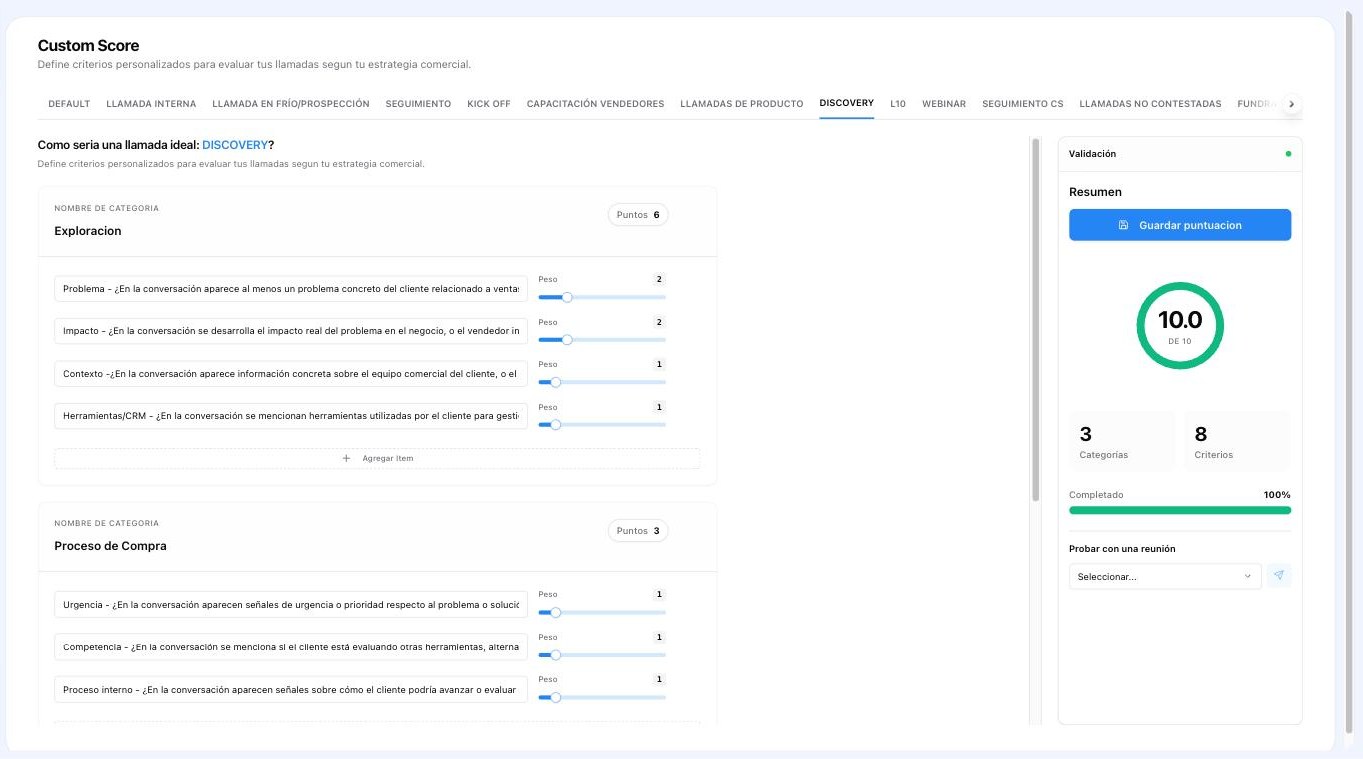
- Categories: the blocks of the call. For example, Opening, Problem Statement, Pitch, and Close; or Discovery Questions and Buying Process for a discovery call.
- Criteria: within each category, binary questions about verifiable facts. "Did the rep ask permission to continue the conversation?", "Is at least one concrete customer problem mentioned?", "Are the tools they currently use brought up?"
- Weights: each criterion carries different weight. If detecting the problem is the critical part of your process, that criterion might be worth 20% while personal introductions are worth 5%. The final score is weighted, not a naive average.
Writing criteria as binary questions is what makes the system auditable: you're not arguing over whether the call "felt good" — you're checking whether a milestone happened or not.
You can test it before using it
While setting it up, the dashboard shows you how many categories and criteria the score has, the percentage of setup completed, and an option to test it against a real meeting before saving it. That's how you calibrate: if the score gives 100% to a call you'd personally call mediocre, the problem is in the criteria, and you fix it right there.
What does the Samu Score look like on a call?
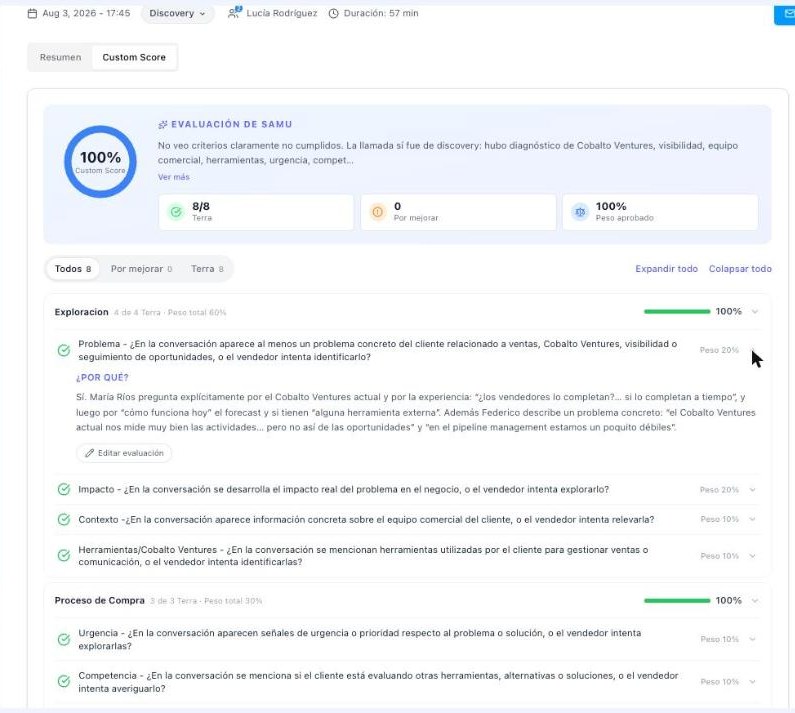
Every analyzed meeting has a Custom Score tab with four things:
- The overall score for that call, as a percentage.
- Samu's assessment: a natural-language summary of what was missing. For example: no brief product explanation, no problem detected, no attempt to book a next meeting.
- Category-level detail: how many criteria passed out of the total, and what percentage of the weight was covered. This shows you whether the call fell apart at the opening or at the close.
- Justification for every criterion. Expanding any item shows a "why?" with the reasoning and the exact quote from the conversation. It's not a black box — you can see the exact phrase the AI used to mark a criterion as met or not.
And if the AI got it wrong, the assessment can be edited by hand. That matters more than it seems: a scoring system the team can't correct feels unfair and gets abandoned within two weeks.
The coaching dashboard: compliance by call type and by rep
A single call's score is useful for one conversation. The management value shows up when you look at it in aggregate.
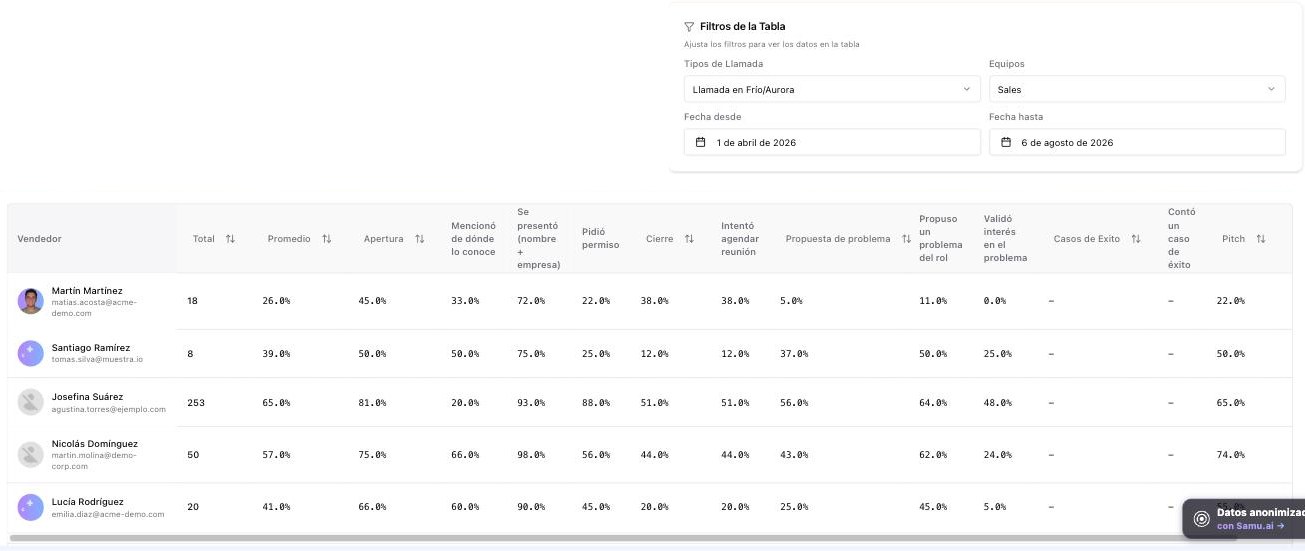
The coaching dashboard shows the average compliance rate per team (Sales, SDR, CS, whatever you run) across all calls in the period. When you filter by call type, the table breaks down by rep, and that's where it gets interesting: a column for every category and every criterion, showing how often that person met it.
That turns a vague conversation into something surgical. It's not "work on your discovery" — it's "in your last 11 discovery calls, you identified the problem 100% of the time, but only asked about the internal buying process 30% of the time." Coaching becomes a conversation about a specific milestone, backed by evidence.
You can also filter by team and date range, and download a monthly report. One thing to note: for the data to be meaningful, the analysis only considers calls with at least two participants and more than five minutes in length.
What can you actually expect?
Fact-based coaching, not opinions
Instead of "I felt like you were weak on discovery," you get "in 7 of your last 10 calls, you talked more than 65% of the time" or "you didn't ask permission to continue the conversation on 60% of your cold calls." Feedback stops being your perception versus the rep's.
Scale
A manager can't listen to 200 calls a week. The AI reviews all of them and shows you where to look. The most valuable insight is usually the aggregate one: if a criterion fails on 40% of the whole team's calls, that's not one person's problem — it's a messaging, process, or training problem.
Consistency against your playbook
This is where a custom score stands apart from generic analysis. If your team runs SPICED, BANT, MEDDIC, or SANDLER, the criteria get written in that vocabulary, and the standard is the same for everyone — it doesn't depend on the mood of whoever's reviewing.
Faster onboarding
A new rep can see, from week one, exactly what's expected on each call type — because it's written as a checklist — and compare their own calls against the top performers.
"I came to Samu for coaching — to review calls and give feedback. What I found was much bigger: it doesn't hand you a generic summary, it focuses on exactly what we defined as important for each type of meeting."
What shouldn't you expect?
It doesn't replace the manager
The AI tells you where to look and why, but the coaching conversation, the empathy, and the decision about how to develop each person stay human. If nobody has the feedback conversation, the data just sits in a dashboard nobody opens.
It doesn't fix a process that doesn't exist
The Samu Score is only as good as the playbook you feed it. If you haven't defined what has to happen on a discovery call, the tool won't invent it for you: define the standard first, then measure it.
It's not magic on day one
The first few days are for calibration: testing the score against real calls, fixing ambiguous criteria, adjusting weights. The real value shows up once the team understands the goal is improvement, not surveillance.
How do you roll out AI coaching on your team?
- Define what a good call looks like, by type. Before configuring anything: what has to happen on a discovery call, a demo, a follow-up.
- Write it as weighted binary criteria. Yes-or-no questions about facts, not impressions.
- Test the score against real calls and adjust before rolling it out to the team.
- Tell the team before turning it on. Explain the purpose, and show them the evaluation can be discussed and edited. This step decides adoption.
- Set a fixed routine. 30 minutes a week per rep, on one specific criterion from the score. Coaching without a routine doesn't happen.
What metrics should you watch in sales coaching?
- Score compliance rate by call type and by rep: the headline metric.
- Most-failed criteria across the team: tell you what to train on next month.
- Talk ratio: how much the rep talks versus the customer. In consultative sales, going above 60-65% is a warning sign.
- Next step booked: what percentage of meetings end with a concrete date.
- Month-over-month trend: the score works less as a snapshot and more as a time series.
If those conversations also flow straight into the CRM on their own, they stop being just a coaching metric and become pipeline intelligence. We cover that in how to integrate sales AI with your CRM.
A concrete case: coaching your team's demos
If you set up a Samu Score for the "demo" call type, the criteria practically write themselves: did the rep reconnect with the discovery context before sharing their screen? Was the end result shown first? Were there verification pauses? Was the next step booked on the call? Every one of those milestones is measurable across every demo your team runs. We break down the reasoning behind each one in our guide on how to run a B2B sales demo.
Frequently asked questions about AI for sales coaching
Is the Samu Score customizable, or does it come predefined?
It's 100% customizable. You define the categories, the criteria, and the weight of each one, separately for every call type. There's no imposed standard — the score reflects your playbook, not someone else's.
What happens if the AI scores a criterion wrong?
Every criterion shows its justification with a quote from the conversation, so you can verify it in seconds. If it's wrong, the assessment can be edited by hand. That ability to correct it is key to the team trusting the system.
Does it work the same for SDRs and AEs?
Yes, and that's exactly why you configure it by call type. A cold call gets scored on opening, permission, and problem statement; a discovery call, on exploration and buying process. On the coaching dashboard, you can compare each team's compliance separately.
Does the team experience it as surveillance?
Depends on how it's introduced. When the standard is public, the criteria are clear, and the evaluation can be discussed, it feels like the rules of the game. When it shows up overnight with no explanation, it feels like control.
How long before it shows results?
The first few days are for calibration. Within the first few weeks, clear patterns already emerge — criteria almost nobody meets, high talk ratios, missing next steps — and those are the fastest changes to fix, because they're behavioral, not product issues.
Does it work well in LATAM Spanish?
That's the weak spot for a lot of tools built in English — they translate words but lose context and local expressions. Samu is built for the region's Spanish, with its country-by-country variations, and that's what separates a useful analysis from a useless one.
Conclusion
AI for coaching doesn't turn a bad manager into a good one, but it gives a good manager back the time and the data to do their job. And a personalized score like the Samu Score solves coaching's underlying problem: everyone gets measured against the same thing, you can audit why a call scored the way it did, and the conversation with the rep starts from a concrete milestone instead of a gut feeling.
Want to see your playbook turned into a score? Set up your own Samu Score and measure it against your team's real calls, with a guarantee: if you don't see value, you don't continue. Request a Samu demo or check out plans and pricing.